Common dental decisions · DENTALVIEW GUIDE
Scaling and health insurance: how often can you get it covered?
Insured scaling is available once per calendar year from age 19. Learn about plaque and tartar, recommended intervals, coverage conditions, when scaling alone isn't enough, and how to check this year's eligibility.
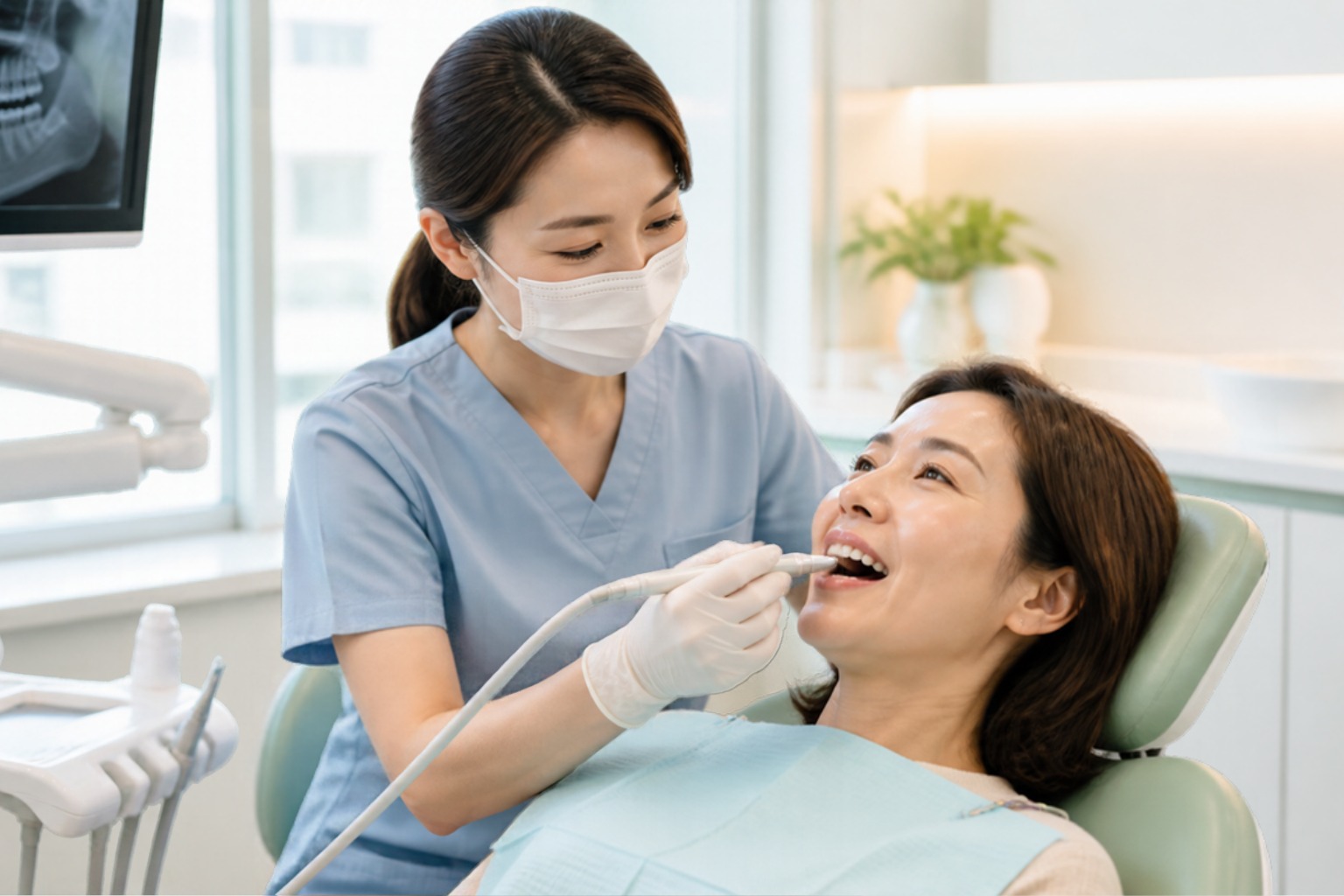
- From age 19, you can use insured scaling once between January 1 and December 31 each year. It runs by calendar year, not a six-month interval.
- Coverage applies when scaling is the sole purpose of that visit. Any other treatment done at the same time follows its own separate criteria.
- Your clinic sets the interval that fits your condition. If tartar builds up quickly or you smoke or have diabetes, a shorter interval than a year may be recommended.
- If you're unsure whether you've used this year's coverage, check the NHIS website or its official mobile app's scaling treatment record lookup.
Tartar does not come off with brushing alone. It forms when plaque hardens, so a clinic has to remove it with an ultrasonic instrument. This procedure is called scaling, and adults aged 19 and over who are insured can use coverage for it once a year.
The reviews below describe visits for scaling or regular dental care. They do not state whether coverage applied or the exact cost, so check your own eligibility and copayment with the clinic or NHIS separately.
01.What exactly does scaling do?
Oral bacteria mix with food debris and saliva to form a thin film called plaque on tooth surfaces. If plaque is not cleared in time, it hardens into tartar, and bacteria attach to tartar more easily, worsening gum inflammation. Scaling is a non-surgical treatment that removes this tartar with an ultrasonic instrument.
It is different from root planing, which smooths the root surface. Scaling focuses on removing tartar above the gumline, and when tartar sits deep inside a periodontal pocket, additional treatment such as root planing may be needed.
One case from a visitor review
First visit for scaling
스케일링하러 방문했는데 친절히 설명잘해주시고 통증없이 잘 해주셔서 또 방문하려고 합니다English translationI visited for scaling and they explained things kindly and did it comfortably, so I plan to come back again.
Related readingScaling vs. periodontal treatment: what differs, and how insurance and recall intervals work
Official sources for this sectionKDCA National Health Information Portal: Gum disease (periodontal disease)
02.How often should you get scaling done?
The KDCA recommends a regular dental check every three to six months and scaling at least once a year. Six to twelve months is commonly suggested when gums are healthy with little tartar, and three to six months when tartar builds up quickly or gums bleed.
A shorter interval may be recommended if a risk factor such as smoking or diabetes affects gum inflammation, or if you have had periodontal treatment before. The clinic sets the exact interval based on your gum condition and risk factors.
One case from a visitor review
Has been getting scaling and checkups on a regular schedule
치아 정기 스케일링과 검진받고 가요. 덕분에 매년 치아를 건강하게 잘 관리중이여요 😆English translationI come in for regular scaling and checkups. Thanks to that, I've been keeping my teeth healthy every year.
Official sources for this sectionKDCA National Health Information Portal: Gum disease (periodontal disease)
03.How does health insurance apply to scaling?
Insured adults aged 19 and over, and their dependents, can use coverage for scaling once between January 1 and December 31 each year. Because eligibility is calculated by calendar year rather than a six-month gap, you can use it in December of one year and again in January of the next.
The copayment rate is 30 percent, roughly 15,000 to 20,000 won at a typical dental clinic. Coverage applies when scaling is the sole procedure that visit; any other treatment done the same day follows its own separate criteria. Under age 19, coverage may apply only as a preparatory step before periodontal surgery. Scaling beyond the one covered session per year is non-covered.
One case from a visitor review
Received both a prosthetic treatment and scaling during the same visit
4층 정원장님 덕분에 어금니 보철치료 잘 하고 6층에서 스켈링 했어요.
스켈링 선생님 친절하고 꼼꼼하게 설명해주고 스켈링 해주셔서 감사합니다English translationThanks to Dr. Jeong on the 4th floor, I had a good molar prosthetic treatment, and then had scaling on the 6th floor. Thanks to the scaling staff for explaining things kindly and carefully.
Related readingWhat to separate in an implant cost estimate
Official sources for this sectionNational Health Insurance Service: scaling coverage guidance
04.When is scaling alone not enough?
Gingivitis, where inflammation stays limited to the gum tissue, often responds to scaling. Periodontitis, where inflammation has spread to the supporting bone and created a periodontal pocket, can require more than scaling above the gumline.
Treatment may then extend to root planing, surgical options such as gingivectomy, and antibiotics when needed. Smoking and diabetes are flagged as risk factors that worsen tissue destruction and reduce treatment effectiveness.
One case from a visitor review
Had only scaling before, but started periodontal treatment this year as well
이사하면서 치과 찾아보다가 주변분 추천으로 작년도부터 스케일링 하고 있는데, 올해부터는 잇몸치료도 받고 있어요.
설명도 친절하게 해주시고 치료도 잘 해주셔서 만족하고 다니고 있습니다.English translationAfter moving, I looked for a clinic and started scaling here last year on a neighbor's recommendation; this year I've also started periodontal treatment. The explanations are kind and the treatment has been good, so I'm satisfied coming here.
Related readingScaling vs. periodontal treatment: what differs, and how insurance and recall intervals work
Official sources for this sectionKDCA National Health Information Portal: Gum disease (periodontal disease)
05.How can you check whether you've already used this year's coverage?
After logging in, you can check this year's eligibility through the NHIS website's or its official mobile app's scaling treatment record lookup. You can also ask the clinic you plan to visit or call the NHIS customer center (1577-1000).
If you do not use it by December 31, that year's coverage simply ends and resets on January 1 of the next year. Appointments tend to fill up toward year's end, so book early if you haven't used it yet.
One case from a visitor review
The clinic reached out first to keep track of regular care
필요한 치료만 권하시니 좋아요. 온가족이 다니고 있음.
잊지않고 정기적으로 알아서 연락주셔서 잘 관리받고있어요~!English translationI like that they only recommend treatment I actually need. Our whole family goes here. They reach out regularly without me having to remember, so I'm well taken care of.
Related readingImplant lifespan and maintenance: how many years is typical?
Official sources for this sectionNational Health Insurance Service: scaling coverage guidance
What should you check when getting scaling?
These topics connect your condition with the coverage rules; they are not a self-scoring form.
| Criterion | Before the visit | At consultation | Interpretation limit |
|---|---|---|---|
| Gum condition | Whether gums bleed or swell when brushing | Whether pocket depth changes the right interval | Bleeding or swelling may lead to a shorter three-to-six-month interval instead of six to twelve. |
| Smoking status | How much and how long you've smoked | A cessation plan or its effect on treatment outcomes | Smokers are reported to have a higher chance of periodontal disease and a worse prognosis after treatment. |
| Diabetes status | Recent blood sugar control | How it affects the extent of tissue destruction | Diabetes is reported to be linked with more severe tissue destruction and higher prevalence and severity. |
| This year's treatment history | Whether you've already used this year's covered scaling | The NHIS lookup result | A second scaling in the same calendar year is non-covered. |
| The purpose of this scaling visit | Whether it's scaling alone or combined with other treatment | Whether it counts as prep before periodontal surgery | Check first that coverage requires scaling to be the only procedure that visit. |
| How quickly tartar builds up | How fast tartar returned since the last scaling | Whether it feels faster than usual | A faster buildup may lead to a recommendation shorter than a year. |
| Systemic conditions and medication | Blood disorders, hormonal changes, current medication | Whether you've already informed the clinic | Hormonal changes such as puberty, pregnancy, menstruation or diabetes, and certain medications, can affect gum inflammation. |
What to verify
Ten questions to ask verbatim
- What scaling interval in months is recommended for my gum condition?
- Will this scaling be covered by insurance or treated as non-covered?
- Can you check whether I've already used this year's covered scaling?
- Are there specific areas where tartar builds up most for me?
- Is scaling alone enough, or do I need additional periodontal treatment?
- Is there an area that needs root planing or surgical treatment?
- How long is bleeding or sensitivity normal after scaling?
- Do smoking or diabetes affect my gum condition or treatment plan?
- When should I book my next regular checkup?
- When should I book to use this year's covered scaling before December 31?
FAQ
FAQ
Is tooth sensitivity after scaling normal?
If tartar had been covering part of the root surface, sensitivity can appear briefly once it's removed and that surface is exposed. It usually eases within a few days to one or two weeks, and avoiding very hot or cold food in the meantime can make it more comfortable. Contact the clinic again if it lasts longer or gets worse.
Is bleeding gums after scaling also fine?
Gums that were already inflamed can bleed a little on the day of the procedure or into the next day when touched by the instrument. If it's a light amount mixed in while brushing, it usually eases within a few days, and brushing gently as usual rather than scrubbing hard is enough during that time. Contact the clinic rather than waiting for your next checkup if bleeding continues or comes with pus or significant swelling.
Does getting scaling too often wear down or damage teeth?
The ultrasonic vibration works by dislodging tartar stuck to the tooth surface, so getting it at the recommended interval does not shave down the tooth itself. There is no particular reason to get it more often than the clinic advises, so if you're curious, it's better to ask what interval fits your own gum condition. Also keep in mind that insurance covers only one session a year, so extra visits are non-covered.
Insured scaling is once a year, but can't I get it every six months?
You can still have scaling every six months, but insurance covers only one session within the calendar year (January 1 to December 31). If the clinic recommends a three-to-six-month interval, the extra visits are non-covered, and the cost can vary between clinics, so check it before booking.
I had scaling last December. Can I use coverage again this January?
Yes, you can. Insured scaling is calculated by the calendar year, not a one-year gap. Even if you used it in December of the previous year, a new year starts a fresh eligibility. Note that the year is determined by the actual treatment date, not the booking date, so if you book for late December, it's worth confirming with the clinic whether the visit falls before or after the new year.
Does scaling alone cure periodontal disease?
Early-stage gingivitis, where inflammation stays in the gum tissue, can often improve with scaling alone. But periodontitis, where a pocket has formed, may need root planing or surgical treatment on top of that, and bone that has already been lost does not come back. Ask your clinic which stage applies at your regular checkup.
Is scaling done differently if you have braces or an implant?
Areas around braces or the margins of an implant restoration can be harder for instruments to reach, so the clinic may approach them more carefully. Telling the clinic which spots you tend to miss with regular brushing lets it check those areas during scaling too. Ask your clinic for the specific method and precautions.
Can someone under 19 use insured scaling?
The general coverage applies to age 19 and over. Those under 19 may be covered only when scaling is done as preparation before periodontal surgery; preventive scaling done simply out of concern about tartar does not automatically qualify for someone under 19. Whether this applies depends on individual circumstances, so check directly with the clinic or NHIS.