Implants · DENTALVIEW GUIDE
Comparing implant surgery methods: navigation, flapless, immediate placement and conscious sedation
The four are not competing methods but names for different things (planning, gum, timing and anesthesia) and can be used together in one operation. Which is better only emerges after your images and general health are reviewed, so ask why that combination was proposed rather than comparing names.
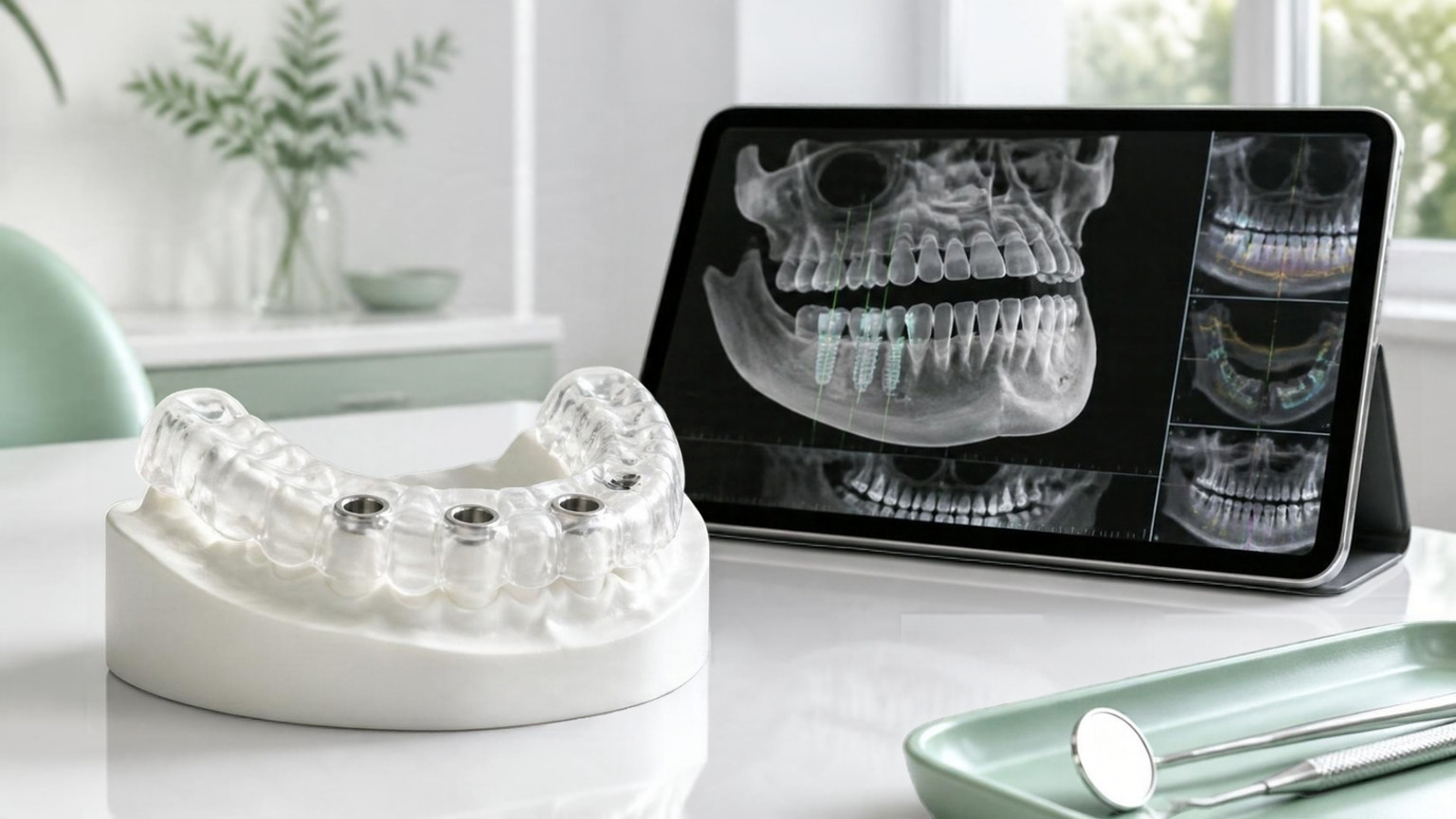
- Navigation plans the implant position in advance from a 3D CT and transfers it with a guide. The ITI consensus report found accuracy acceptable in most clinical situations but advised keeping a safety margin of at least 2 mm.
- Flapless surgery places the implant without opening the gum. A 2014 meta-analysis found a difference in failure risk that changed with study quality and had to be read cautiously, and no difference in infection or marginal bone loss.
- Immediate placement names the timing: placing the implant on the day of extraction. A Cochrane review found too little evidence to conclude the pros and cons of immediate, immediate-delayed and delayed placement, and it is a separate matter from same-day temporary teeth.
- Conscious sedation names the anesthesia method. The Korean Dental Association says the term 'sleep implant' should not be used and the procedure should be called conscious sedation: the patient does not truly sleep but keeps responding and breathing, and oxygen saturation and breathing must be monitored continuously.
The first thing to know when comparing implant surgery methods is that navigation, flapless surgery, immediate placement and conscious sedation are not choices on the same level. The first two describe how surgery is planned and performed, the third describes timing and the fourth describes anesthesia, so one operation may use all four or none.
That is why 'which method is better' is hard to answer, and why it helps to ask how planning, the gum, timing and anesthesia were each decided for your operation. This guide summarizes what published studies and guidance say and do not say about each method and what to confirm at a consultation; it does not judge whether any method suits you.
01.The four names answer different questions
Navigation answers how the position, angle and depth are decided and transferred, flapless surgery answers how the gum is handled, immediate placement answers when the implant is placed, and conscious sedation answers which anesthesia is used. When clinics lead with different names for the same operation, they are emphasizing different parts, not offering interchangeable methods.
At a consultation, rather than memorizing the names, put four boxes in front of you (planning, gum, timing, anesthesia) and ask what is proposed for each in your case and where in your images and health history the reasoning comes from. The KDCA also describes oral examination, imaging and a check for systemic disease as part of the process, so all four choices should start from those results.
- Planning: what did you look at to decide the position, angle and depth?
- Gum: can it be done without opening, and if opening is needed, why?
- Timing: on what condition was same-day or delayed placement decided?
- Anesthesia: local only or with sedation, and who decides?
Official sources for this sectionKDCA National Health Information Portal: Dental implant
02.What does navigation implant surgery decide in advance?
Navigation or guided surgery plans the position, angle and depth on a computer from 3D CT and oral scan data and transfers that plan with a surgical guide. Clinic websites describe it as mock surgery, guides or one-guide systems; that is information published by the clinic, so which guide is used at which stage must be confirmed at the consultation.
The systematic review in the ITI consensus report concluded that the accuracy of static guided surgery is within the clinically acceptable range in most situations but that a safety margin of at least 2 mm should be respected, and it reported better accuracy in partially edentulous patients than in fully edentulous ones. That means errors can still occur with a guide, so it is more accurate to see a guide as a tool for transferring a plan rather than a substitute for the clinician's judgment.
- Ask where the guide is supported: tooth, mucosa or bone.
- Check whether guide fabrication and CT planning appear as separate lines in the estimate.
- Hear when the plan can change during surgery and how that is handled.
Official sources for this sectionITI 합의 보고 정적 컴퓨터 보조 임플란트 수술 정확도 체계적 문헌고찰(Tahmaseb 등, 2018)
03.Under what conditions is flapless surgery described as possible?
Flapless implant surgery places the implant through a small opening without opening the gum widely. Clinic descriptions often mention less bleeding and swelling and faster recovery, but whether it is possible depends on gum thickness, bone width and height, and whether the position is clearly visible in imaging, so it does not apply to every case.
A meta-analysis published in PLoS ONE in 2014 analyzed 23 publications and reported a failure risk ratio of 1.75 for flapless surgery, but said the result had to be interpreted carefully because it differed when studies with high and low risk of bias were pooled separately. There was no significant difference in postoperative infection or marginal bone loss, and the authors called for larger randomized trials, so the conclusion this evidence allows is that flapless surgery cannot be called always better or always worse.
- Ask what could make an incision necessary and how cost and schedule would change.
- Check first whether the site needs bone grafting or a sinus procedure.
- Ask what basis the 'faster recovery' statement comes from.
Official sources for this section무절개와 절개 임플란트 수술 비교 메타분석(Chrcanovic 등, PLoS ONE 2014)
04.When is placing an implant on the day of extraction possible?
Immediate placement puts the implant in the socket on the same day the tooth is removed, and it is distinguished from immediate-delayed placement after days to weeks and delayed placement after the bone has healed. Whether it is possible depends on inflammation around the tooth, how much of the bone wall remains and gum thickness, so it must be decided from imaging and examination before extraction.
The Cochrane systematic review (2010) found the evidence insufficient to conclude the pros and cons of immediate, immediate-delayed and delayed placement because many trials were small with a high risk of bias, and it raised the possibility that failure or complications may be higher with immediate placement while the esthetic result may be better. The review is old and later studies may have been added, so do not assume one is better; ask what the alternative of waiting would be for your own socket. Attaching a temporary tooth on the day (immediate loading) is a separate decision from placement timing and should be confirmed separately.
- Ask to see the inflammation and bone wall around the tooth on the images.
- Ask whether waiting is an alternative and how schedule and cost would change.
- Check whether a temporary tooth is attached that day and how chewing is restricted.
Official sources for this sectionCochrane 발치와 임플란트 식립 시기 비교(Esposito 등, 2010)
05.What should you ask separately about conscious sedation?
Ads often say 'sleep implant', but in a press release dated 28 January 2026 the Korean Dental Association said the term can make the risks seem lower, is not permitted in medical advertising, and should be replaced with conscious sedation. Conscious sedation does not actually put you to sleep: it reduces anxiety while you keep responding to stimuli and breathing on your own, and because you may not remember the procedure it can feel as if you slept.
Safety lies in the verification steps rather than the name. The Korean Dental Association said indications, medication use, real-time patient monitoring and an emergency response system should be considered in advance. The American Dental Association's revised guidelines adopted in October 2025 also emphasize checking physical status and fasting, time-based drug records, supplemental oxygen, and emergency preparedness with repeated drills. The American guidelines are not a standard that applies directly in Korea, so treat them as a reference and ask the clinic directly who manages the sedation and what is monitored.
- Ask who manages the sedation and whether someone other than the surgeon monitors you.
- Check what equipment continuously monitors oxygen saturation and breathing.
- Report your medicines and conditions and get fasting instructions in writing.
Official sources for this section대한치과의사협회 의식하진정법 안전관리 및 의료광고 원칙 입장(2026.01.28) / American Dental Association 치과 진정·전신마취 사용 지침 개정 발표(2026)
Compare the four on one form
A blank in the table does not mean a poor rating; it means no answer has been received yet. Fill it only from consultation explanations and written documents, not from the wording of clinic advertising.
| Criterion | Before the visit | At consultation | Interpretation limit |
|---|---|---|---|
| What it changes | Whether the clinic's term means planning, gum, timing or anesthesia | How each of the four was decided for my operation | The four names are not choices on the same level. |
| Examination needed | Whether 3D CT and oral scanning are done | What in my images led to this proposal | A registered CT count is a capacity signal, not a substitute for my own examination. |
| When it is difficult | Whether the material lists conditions that limit use | Which conditions do not apply to my case | Promotional text without limits does not mean it works for every case. |
| Added cost | Whether guides, sedation and grafting are listed as separate items | Whether the estimate itemizes each and how changes are settled | Item-level fees for each clinic are in the price comparison guides. |
| Clinician and equipment | Whether the specialty of the staff handling surgery and sedation is published | Who plans, operates and monitors the sedation | Website staff counts and HIRA-reported numbers can differ and should be read separately. |
| Recovery and follow-up | The stated recovery period and post-operative instructions | Which symptoms require contact before the appointment | A clinic's recovery description is a general statement and varies widely by person. |
| Evidence and limits | The conclusions and years of published studies or guidelines | Whether that evidence applies to my situation | Study results are group averages and do not guarantee an individual outcome. |
What to verify
Ten questions to ask verbatim
- How did you decide planning, gum handling, timing and anesthesia for my operation?
- Can you point out on my images what led you to propose this method?
- If a guide is used, how is it supported, and when might the plan change during surgery?
- Can it be done without opening the gum, and if not, why and what changes in cost?
- Between same-day and delayed placement, which fits my case and why?
- Will a temporary tooth be attached that day, and how should I restrict chewing?
- If sedation is used, is it conscious sedation, to what level, and who manages it?
- Is there someone separate from the surgeon who monitors breathing and oxygen saturation?
- How are medicines, conditions and fasting time handled, and can I get this in writing?
- Does the estimate itemize guide, sedation and grafting, and how are changes settled?
FAQ
FAQ
Is navigation implant surgery safer than conventional surgery?
It is hard to say it is safer. The systematic review in the ITI consensus report found accuracy of static guided surgery within the clinically acceptable range in most situations but advised a safety margin of at least 2 mm, and errors can still occur with a guide. A guide is a tool for transferring a plan, so also ask what images the plan itself was built from and who reviewed it before surgery.
Is flapless surgery less painful with faster recovery?
Clinic descriptions often say so, but published studies do not confirm it. The 2014 meta-analysis found no significant difference in postoperative infection or marginal bone loss, and said the failure-risk result varied with study quality and had to be read cautiously. Pain and recovery vary widely between people, so ask for a specific expectation for your own case rather than a general claim.
Are flapless surgery and navigation the same thing?
They are not the same. Flapless surgery means the gum is not opened, while navigation means planning the position in advance from a 3D CT and transferring it with a guide. They are often used together and can sound like one thing, but they are independent choices: a guide can be used with an incision, and flapless surgery can be done without a guide.
With immediate placement, do I also get a new tooth the same day?
Not necessarily. Immediate placement names the timing of putting the implant in on the day of extraction, while attaching a temporary tooth that day (immediate loading) is a separate decision. Even when a temporary tooth is attached, chewing often has to be restricted, so confirm separately at the consultation whether a temporary tooth is placed and what limits apply in daily life.
Are 'sleep implants' and conscious sedation the same?
What ads call a sleep implant usually means conscious sedation, but the Korean Dental Association's position is that the word sleep makes the risk look low, should not be used in medical advertising, and that conscious sedation should be used instead. You do not actually fall asleep but keep responding and breathing on your own, so if an ad says sleep, ask what sedation is used and to what level.
What must I tell the clinic before conscious sedation?
Tell the clinic your medicines and injections, diagnosed conditions and how well they are controlled, any trouble with earlier anesthesia, possible pregnancy and allergies. The American Dental Association's revised guidelines also treat checking physical status and fasting as central, so get the fasting time and instructions about that day's medicines in writing and ask who will monitor you during sedation.
Which of the four surgical methods is best?
There is no single best method. The four names refer to different things (planning, gum, timing and anesthesia), so they cannot be ranked, and which combination fits is decided after your images and general health are reviewed. The basis for comparison is not the names but being told why each was chosen for your operation.
Does the surgical method change the cost?
It can. Guide fabrication, sedation and grafting are sometimes listed as separate items from the implant fee and sometimes included, depending on the clinic, so check whether each appears as its own line in the estimate and how changes are settled. Item-level fees by clinic can be seen on the same basis in the Yeonsu-gu and Seoul National University Station price comparison guides.