Implants · DENTALVIEW GUIDE
Sleep implant explained: conscious sedation vs general anesthesia, pain, cost, and risks
Sleep implant is not a formal operation name but implant care performed with sedative medication. Conscious sedation aims to preserve purposeful response and spontaneous breathing, while local anesthesia separately controls pain; confirm the actual depth, monitoring, and discharge criteria.
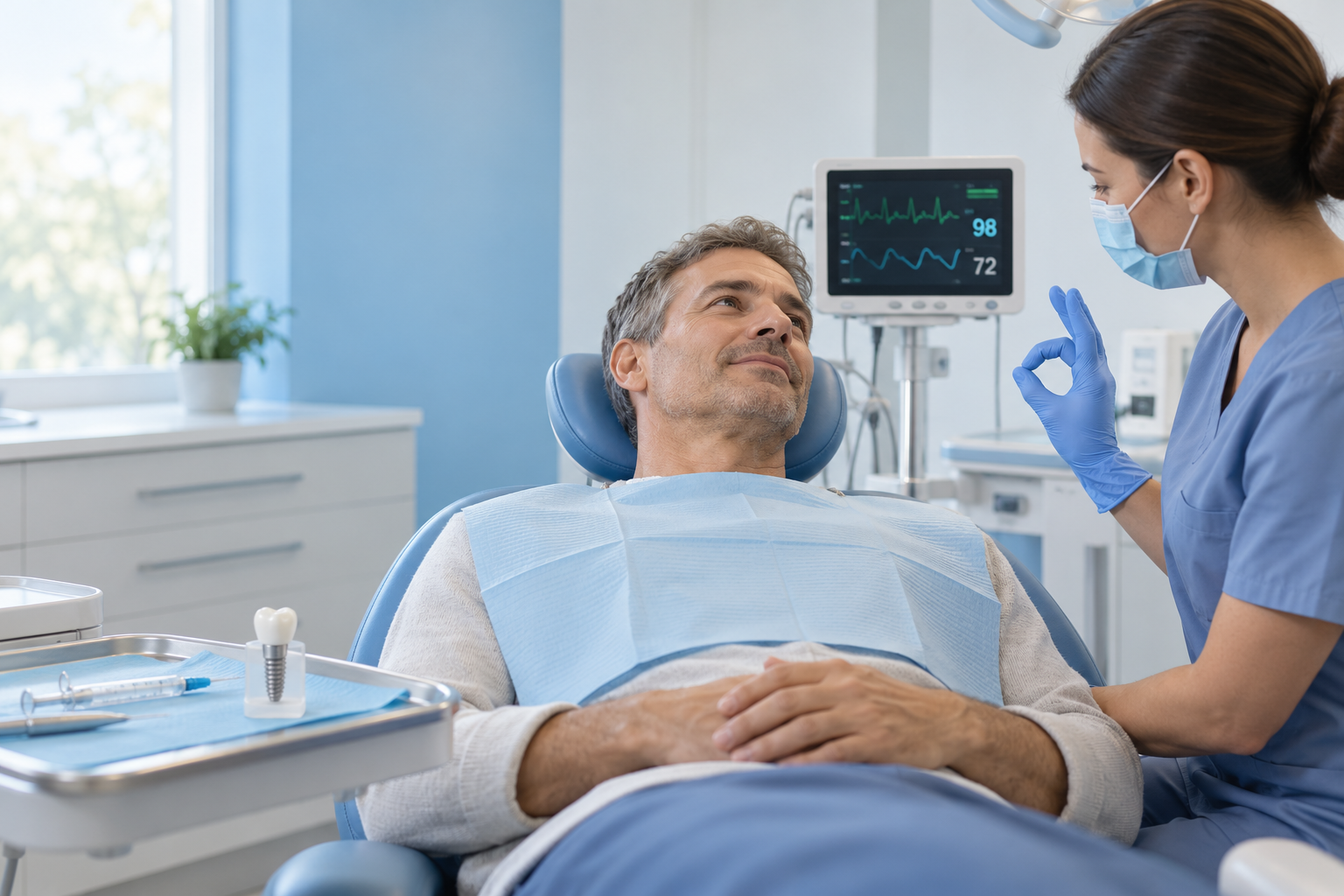
- A clinic's sleep implant label does not define one uniform sedation level. Ask first whether the intended level is moderate conscious sedation, deep sedation, or general anesthesia.
- During moderate conscious sedation, purposeful response and spontaneous breathing are generally preserved. Under general anesthesia, the patient is not arousable even by painful stimulation and airway or ventilation support is commonly required.
- Sedatives are used for anxiety and memory, while local anesthesia separately controls procedural pain. Before comparing price, confirm the drug, intended depth, monitoring clinician, fasting and medicines, escort, and discharge rules in writing.
The central question is not whether you appear asleep, but how deep the sedation is intended to be and who monitors breathing and circulation. Dental sedation is a continuum from minimal and moderate sedation to deep sedation and general anesthesia, and the same drug can produce different depths depending on dose, titration, combinations, and individual response.
Five peer-reviewed papers cover sedation definitions, adult dental anxiety, implant-patient responses, drug differences, and measured sedation depth. These cases show a range of possible outcomes rather than predicting an individual's result; suitability requires clinical assessment of medical history, airway, medicines, and procedure.
01.How does conscious sedation differ from general anesthesia?
Moderate conscious sedation depresses consciousness while preserving purposeful response to verbal or light tactile stimulation, with the airway and spontaneous ventilation generally maintained. General anesthesia produces unresponsiveness even to painful stimulation and commonly requires airway and ventilatory support. The intended depth and response target matter more than the marketing word sleep.
A 2016 peer-reviewed review describes sedation as a continuum requiring patient selection, titration, monitoring, and emergency preparedness. It also states that sedation does not replace local anesthesia: the operative site still needs adequate local pain control, and deepening sedation to compensate for inadequate local anesthesia should be avoided.
- Ask about intended depth and response criteria, not only the drug name.
- Confirm the separate local-anesthesia plan for pain control.
- Ask how the team rescues and supports breathing if sedation becomes deeper than intended.
Official sources for this section치과 경구·흡입·정맥 진정 기법 문헌고찰(Harbuz·O'Halloran, 2016)
02.Have highly anxious implant patients still reported low satisfaction?
Yes. In an observational study of 102 implant patients treated with local anesthesia and intravenous conscious sedation, preoperative anxiety was low in 27.8%, moderate in 50.0%, and high in 22.2%. Patients rated the experience comfortable in 23.3%, neutral in 28.9%, slightly uncomfortable in 36.7%, and very uncomfortable in 10.0%; higher preoperative anxiety was associated with lower satisfaction.
Not every sedated patient reported comfort or complete amnesia. The study was uncontrolled, observational, and published in 2010, so it cannot be generalized to every modern drug regimen or clinic. A 2024 meta-analysis likewise found only low-certainty evidence that benzodiazepines reduce state anxiety during oral surgery and separated short-term procedural anxiety from chronic dental phobia, for which approaches such as cognitive behavioral therapy may be relevant.
- Describe prior dental fear and anesthesia experiences before sedation planning.
- Do not expect a guarantee of complete amnesia.
- Discuss separately whether persistent dental phobia needs longer-term care.
Official sources for this section임플란트 의식하진정 수술 전 불안과 만족도 관찰연구(González-Lemonnier 등, 2010) / 성인 치과 불안 중재 무작위시험 체계적 문헌고찰·메타분석(Steenen 등, 2024)
03.Can the drug and depth differ even under the same conscious-sedation label?
In a 2021 randomized trial of 43 patients receiving two to five implants, the dexmedetomidine group reported less pain, greater satisfaction, and less desaturation, while sedation began faster with midazolam. Mean operation times were 52.09 and 87.14 minutes, respectively. With only 43 participants and two specific regimens, this does not establish one universally superior drug. Drug selection should consider respiratory change, recovery, procedure time, and medical history rather than onset speed alone.
A 2023 case series of 26 dental patients receiving moderate IV sedation used a mean 1.5 mg of midazolam with propofol infusion; about 85% recalled little or nothing and 92% reported satisfaction. Yet the authors also observed that an EEG-derived depth value did not always align with the clinical sedation scale. A drug name or the word sleep therefore cannot establish actual depth; response, breathing, oxygenation, and circulation must be assessed together.
- Ask about drug, combinations, route, and intended depth together.
- Confirm continuous assessment of breathing and oxygenation, not only apparent sleepiness.
- Do not use small single-center study percentages to predict your own outcome.
Official sources for this section임플란트 의식하진정 덱스메데토미딘·미다졸람 무작위시험(Guldiken 등, 2021) / 치과 정맥 중등도 진정 깊이 SedLine 사례연구(Miyake 등, 2023)
04.Who may consider sedation, and what must be assessed first?
Sedation may be discussed for severe dental fear, pronounced gag reflex, difficulty tolerating awake treatment, or a long procedure where anxiety and movement need management. Implant count alone does not determine suitability. Previous sedation response, sleep apnea or respiratory disease, cardiovascular, hepatic and renal status, possible pregnancy, allergies, and all medicines and injections require review.
Preparation instructions depend on the individual plan. Obtain written directions for fasting start time, water, diabetes medicines or insulin, anticoagulants, and usual medicines; never change them on your own. Ask who is dedicated to monitoring response, blood pressure, pulse, oxygen saturation, and ventilation, and whether oxygen, airway equipment, reversal agents, and an emergency transfer plan are available.
- Share recent results and control status, not only diagnosis names.
- Follow individualized clinic instructions for fasting and medication rather than a generic online table.
- Ask how procedural and sedation-monitoring roles are divided.
Official sources for this section치과 경구·흡입·정맥 진정 기법 문헌고찰(Harbuz·O'Halloran, 2016)
05.How should cost and discharge planning be compared?
A single sedation fee can hide important differences. Request separate lines for pre-assessment, sedation personnel, drugs and monitoring time, recovery observation, implant placement and local anesthesia, grafting or sinus procedures, abutment and final crown, and charges if the plan changes. The actual total can only be understood by comparing the individual treatment plan with the clinic estimate on the same terms.
Discharge is a safety decision separate from price. Confirm that response and vital signs meet the clinic's recovery criteria, whether an escort is required, restrictions on driving, machinery and alcohol, who will observe you at home, warning symptoms such as vomiting, breathing difficulty or persistent bleeding, and the after-hours contact. Because memory may be impaired, written instructions obtained before treatment are more useful than new explanations heard only after sedation.
- Separate sedation from implant, prosthetic, and additional-procedure fees.
- Confirm recovery and escort rules before booking.
- Obtain written driving restrictions and emergency-contact criteria.
Official sources for this section치과 경구·흡입·정맥 진정 기법 문헌고찰(Harbuz·O'Halloran, 2016) / 치과 정맥 중등도 진정 깊이 SedLine 사례연구(Miyake 등, 2023)
How can conscious sedation and general anesthesia be compared at a glance?
This table summarizes common distinctions used in peer-reviewed literature. Individual depth requires assessment of medical history, airway, procedure, personnel, and rescue resources.
| Criterion | Before the visit | At consultation | Interpretation limit |
|---|---|---|---|
| Target consciousness | Depressed consciousness with response preserved | Confirm intended depth in writing | The word sleep does not define depth |
| Response | Purposeful response to voice or light touch | Ask how response is assessed | Response may diminish if sedation deepens |
| Airway and breathing | Usually maintained in moderate sedation | Confirm respiratory monitoring and rescue equipment | General anesthesia commonly needs support |
| Pain control | Local anesthesia used separately | Confirm local-anesthesia plan and supplementation | Do not mask pain by deepening sedation alone |
| Memory | Recall may be partial or minimal | Set expectations rather than seek a guarantee | Varies by person and regimen |
| Preparation | Assessment, fasting, and medicine instructions | Obtain individualized written instructions | Do not fast or stop medicines on your own |
| Recovery and discharge | Discharge after recovery criteria, often with escort | Confirm driving limits and after-hours contact | Judgment and memory may remain impaired |
What to verify
Ten questions to ask verbatim
- Does your sleep implant service mean moderate conscious sedation, deep sedation, or general anesthesia?
- Which drugs and route are used, and what depth is intended?
- How will local anesthesia control pain at the implant site?
- Do my conditions, sleep apnea, or medicines change the sedation plan?
- When does fasting begin, and how should I handle water and regular medicines?
- Who is dedicated to sedation and respiratory monitoring during the procedure?
- How are oxygenation, ventilation, blood pressure, and pulse continuously assessed?
- What rescue process is used if sedation becomes too deep or breathing weakens?
- Does the sedation fee include assessment, drugs, monitoring, recovery, and escort guidance?
- Can I receive written discharge criteria, escort and driving rules, and an after-hours contact?
FAQ
FAQ
Are patients truly asleep during a sleep implant procedure?
The marketing phrase usually refers to conscious sedation, but the drug regimen and intended depth can differ by clinic. Under moderate conscious sedation, a patient may look sleepy yet still respond purposefully to verbal or light tactile stimulation and generally breathe spontaneously. Deep sedation and general anesthesia involve different responsiveness and airway needs, so confirm the exact level, provider, monitoring, and rescue plan before booking.
Does conscious sedation make implant surgery painless?
Sedative medication mainly reduces anxiety, tension, and memory; local anesthesia separately controls pain at the surgical site. A peer-reviewed dental sedation review states that adequate local anesthesia should accompany sedation and that clinicians should not compensate for inadequate local pain control merely by deepening sedation. Ask how pain will be communicated and when local anesthesia will be supplemented during the procedure.
What is the main difference between conscious sedation and general anesthesia?
The central difference is purposeful responsiveness and the ability to maintain the airway and ventilation. During moderate conscious sedation, patients usually respond to voice or light touch and maintain spontaneous breathing; during general anesthesia, they are not arousable even by painful stimulation and commonly require airway and ventilatory support. Actual depth is assessed from response and physiology rather than the drug name alone.
Will conscious sedation erase all memory of implant surgery?
Complete amnesia cannot be guaranteed. In a 26-patient case series of moderate IV dental sedation, about 85% reported little or no recall, meaning some retained memory; an implant trial also found no clear between-drug difference in retrograde amnesia. Recall varies with drug, dose, depth, and individual response, so ask the team to explain the intended effect and its limits.
Can anyone with severe dental fear receive conscious sedation?
Severe dental fear can be a reason to discuss sedation, but it is not an automatic indication. Sleep apnea, respiratory disease, cardiovascular, hepatic and renal status, possible pregnancy, allergies, medicines, previous anesthesia response, airway, and procedure all require assessment. Sedation manages acute procedural anxiety; treatment of persistent dental phobia has a different purpose and may need a separate plan.
How long should I fast before implant sedation?
One fasting duration does not apply to every patient. Instructions can vary with intended depth, route, procedure time, diabetes or gastrointestinal status, and medicines, so obtain individualized written directions from the treating clinic. Do not independently stop water, diabetes medicines, insulin, anticoagulants, or blood-pressure treatment; clarify each item when the appointment is arranged.
What can be included in a conscious-sedation implant fee?
The bundled scope varies by clinic, so a single sedation line does not show the total. Ask for separate amounts for pre-assessment, sedation personnel, drugs and monitoring time, recovery observation, implant placement and local anesthesia, graft or sinus procedures, abutment and final crown, and charges if the plan changes. Compare value-added tax and recovery or escort conditions on the same basis.
Can I drive home alone after implant sedation?
Even when sleepiness fades, judgment, balance, and memory may not be fully restored after sedation, so follow the clinic's discharge instructions. Confirm before booking whether an escort is required, how long driving, machinery, and alcohol are restricted, and who should observe you at home. Obtain written warning symptoms such as breathing difficulty, repeated vomiting, or persistent bleeding and an after-hours contact.