Implants · DENTALVIEW GUIDE
A framework for comparing implants, bridges and dentures
Available options depend on oral findings; after diagnosis, compare scope, maintenance, timeline and cost in one table.
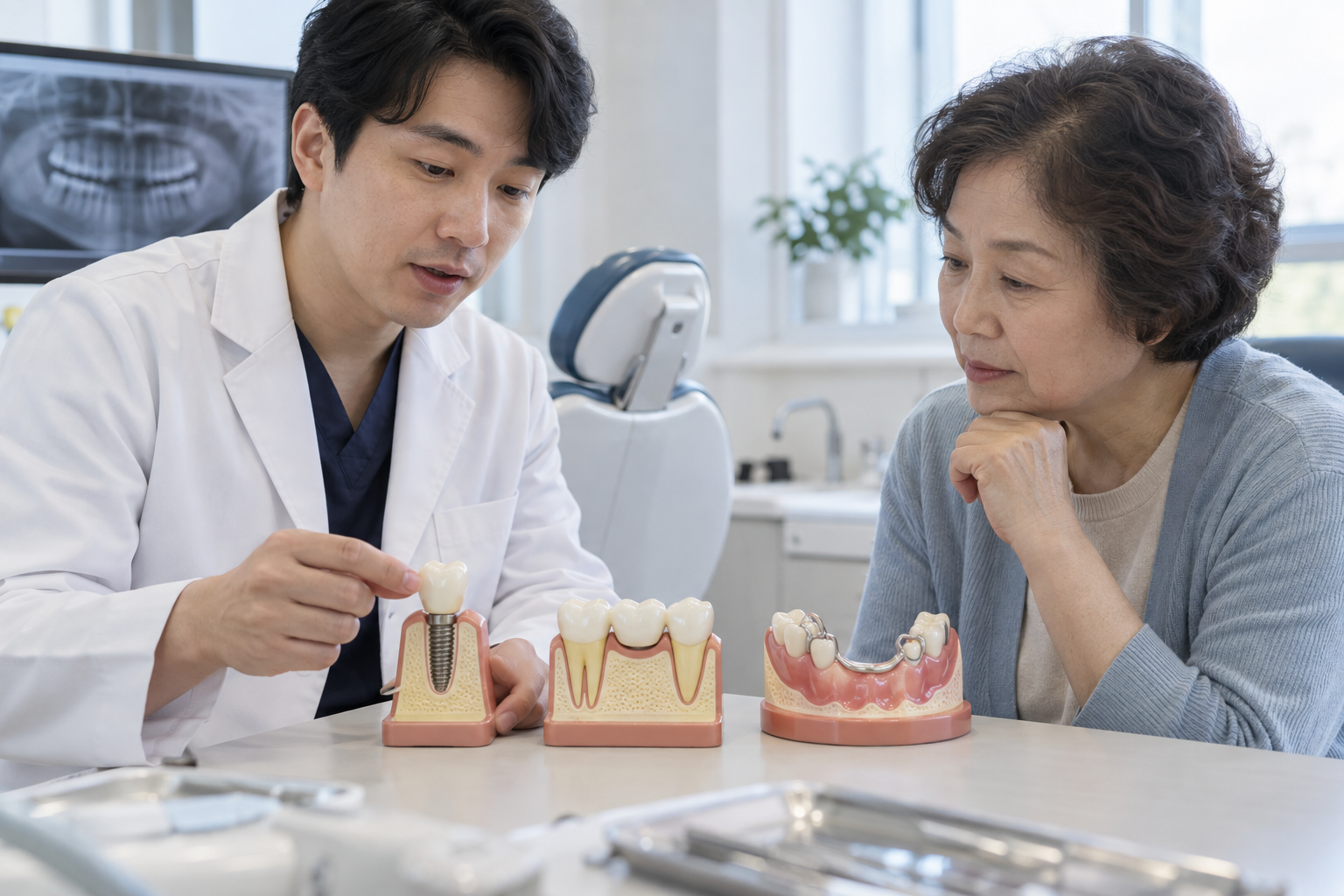
Available options depend on oral findings; after diagnosis, compare scope, maintenance, timeline and cost in one table.
Implants, bridges and dentures are choices with different prerequisites and maintenance burdens, not three prices. Start with the pattern of missing teeth and remaining support.
No method is universally superior. After examination, compare realistic choices by adjacent-tooth effects, surgery, visits, repair and retreatment.
1. Map the missing-tooth pattern and support
A single gap, multiple gaps and a free-end gap offer different support options.
Mark missing teeth, remaining teeth, bone and gum findings on one diagram. The gap label alone cannot determine feasible treatment.
- Mark missing teeth, remaining teeth, bone and gum findings on one diagram.
- The gap label alone cannot determine feasible treatment.
Official sources for this sectionKDCA National Health Information Portal: Dental implant / 국민건강보험공단 치과임플란트 급여안내
2. Compare effects on adjacent teeth
A bridge depends on prepared abutment teeth; an implant avoids direct tooth support but requires a suitable surgical site.
Record effects on sound tooth tissue, existing crowns and periodontal condition. One benefit such as avoiding preparation does not establish overall suitability.
- Record effects on sound tooth tissue, existing crowns and periodontal condition.
- One benefit such as avoiding preparation does not establish overall suitability.
Official sources for this sectionKDCA National Health Information Portal: Dental implant / 국민건강보험공단 치과임플란트 급여안내
3. Compare surgery, adaptation and timeline
Implants center on surgery and healing, dentures on adaptation and adjustment, and bridges on abutment treatment.
Compare visits, temporary solutions, eating limits and important dates. Advertised timelines may omit individual healing and added care.
- Compare visits, temporary solutions, eating limits and important dates.
- Advertised timelines may omit individual healing and added care.
Official sources for this sectionKDCA National Health Information Portal: Dental implant / 국민건강보험공단 치과임플란트 급여안내
4. Test daily cleaning demands
Implant contacts, under a bridge, and denture or mucosal surfaces require different tools and dexterity.
Practice on a model and assess whether the routine is sustainable. A theoretically favorable option may be unrealistic if maintenance is unsustainable.
- Practice on a model and assess whether the routine is sustainable.
- A theoretically favorable option may be unrealistic if maintenance is unsustainable.
Official sources for this sectionKDCA National Health Information Portal: Dental implant / 국민건강보험공단 치과임플란트 급여안내
5. Compare long-term repair and retreatment
Parts, fractures, abutment-tooth problems and denture relining or remake create different repair paths.
Record maintenance, repair and complete-remake conditions separately from initial cost. Average lifespan figures do not predict an individual's failure timing or mode.
- Record maintenance, repair and complete-remake conditions separately from initial cost.
- Average lifespan figures do not predict an individual's failure timing or mode.
Official sources for this sectionKDCA National Health Information Portal: Dental implant / 국민건강보험공단 치과임플란트 급여안내
A same-condition consultation table
Record the evidence, effect on your plan and unresolved condition—not only yes or no.
| Criterion | Before the visit | At consultation | Interpretation limit |
|---|---|---|---|
| Map the missing-tooth pattern and support | Mark missing teeth, remaining teeth, bone and gum findings on one diagram. | What prerequisites make each method feasible for my pattern? | The gap label alone cannot determine feasible treatment. |
| Compare effects on adjacent teeth | Record effects on sound tooth tissue, existing crowns and periodontal condition. | What benefit and burden does each option place on adjacent teeth? | One benefit such as avoiding preparation does not establish overall suitability. |
| Compare surgery, adaptation and timeline | Compare visits, temporary solutions, eating limits and important dates. | What is the visit sequence and temporary option for each choice? | Advertised timelines may omit individual healing and added care. |
| Test daily cleaning demands | Practice on a model and assess whether the routine is sustainable. | Where and with what tool must each option be cleaned daily? | A theoretically favorable option may be unrealistic if maintenance is unsustainable. |
| Compare long-term repair and retreatment | Record maintenance, repair and complete-remake conditions separately from initial cost. | When is a partial repair versus full retreatment needed? | Average lifespan figures do not predict an individual's failure timing or mode. |
| Cost by stage | Separate tests, placement, prosthesis and care | What triggers extra cost? | A headline price may not cover the full course |
| Clinician and follow-up | Record names and contact route | Who handles changes or urgent issues? | Institution size does not prove continuity |
What to verify
Ten questions to ask verbatim
- What prerequisites make each method feasible for my pattern?
- What benefit and burden does each option place on adjacent teeth?
- What is the visit sequence and temporary option for each choice?
- Where and with what tool must each option be cleaned daily?
- When is a partial repair versus full retreatment needed?
- What is confirmed now, and what waits for further tests?
- What realistic alternatives include tooth preservation, a bridge or a denture?
- Can I receive stage costs and added-cost triggers in writing?
- Who actually handles each stage, and how are handoffs managed?
- How do I distinguish expected recovery from reasons to call promptly?
FAQ
FAQ
What matters most when checking map the missing-tooth pattern and support?
A single gap, multiple gaps and a free-end gap offer different support options. Mark missing teeth, remaining teeth, bone and gum findings on one diagram. The gap label alone cannot determine feasible treatment. At consultation, ask “What prerequisites make each method feasible for my pattern?” and record both the supporting finding and anything still unresolved.
What matters most when checking compare effects on adjacent teeth?
A bridge depends on prepared abutment teeth; an implant avoids direct tooth support but requires a suitable surgical site. Record effects on sound tooth tissue, existing crowns and periodontal condition. One benefit such as avoiding preparation does not establish overall suitability. At consultation, ask “What benefit and burden does each option place on adjacent teeth?” and record both the supporting finding and anything still unresolved.
What matters most when checking compare surgery, adaptation and timeline?
Implants center on surgery and healing, dentures on adaptation and adjustment, and bridges on abutment treatment. Compare visits, temporary solutions, eating limits and important dates. Advertised timelines may omit individual healing and added care. At consultation, ask “What is the visit sequence and temporary option for each choice?” and record both the supporting finding and anything still unresolved.
What matters most when checking test daily cleaning demands?
Implant contacts, under a bridge, and denture or mucosal surfaces require different tools and dexterity. Practice on a model and assess whether the routine is sustainable. A theoretically favorable option may be unrealistic if maintenance is unsustainable. At consultation, ask “Where and with what tool must each option be cleaned daily?” and record both the supporting finding and anything still unresolved.
What matters most when checking compare long-term repair and retreatment?
Parts, fractures, abutment-tooth problems and denture relining or remake create different repair paths. Record maintenance, repair and complete-remake conditions separately from initial cost. Average lifespan figures do not predict an individual's failure timing or mode. At consultation, ask “When is a partial repair versus full retreatment needed?” and record both the supporting finding and anything still unresolved.
Can online information settle this decision?
Implants, bridges and dentures are choices with different prerequisites and maintenance burdens, not three prices. Start with the pattern of missing teeth and remaining support. Online information is a starting point for questions, not a substitute for examination and the treating clinician's explanation. Use these items as a checklist and mark missing information as unverified, not absent.
If two clinics disagree, what should I align first?
No method is universally superior. After examination, compare realistic choices by adjacent-tooth effects, surgery, visits, repair and retreatment. First confirm that both clinics used the same records, goals and cost scope, then document why their answers differ and which further tests each needs. Align the actual clinician and follow-up scope as well as price and time.
When should I pause and seek more information?
A bridge depends on prepared abutment teeth; an implant avoids direct tooth support but requires a suitable surgical site. Pause when the supporting findings, actual clinician, total scope or problem-response plan remains unclear. Ask for the missing record before committing; only an examining clinician can judge urgency. Record when the review will be completed and the next action so necessary care is not lost during the pause.