Crowns & prosthodontics · DENTALVIEW GUIDE
How to compare clinics for crowns and prosthodontics
Compare diagnosis, tooth preparation, material rationale, temporary restoration, bite adjustment and return conditions.
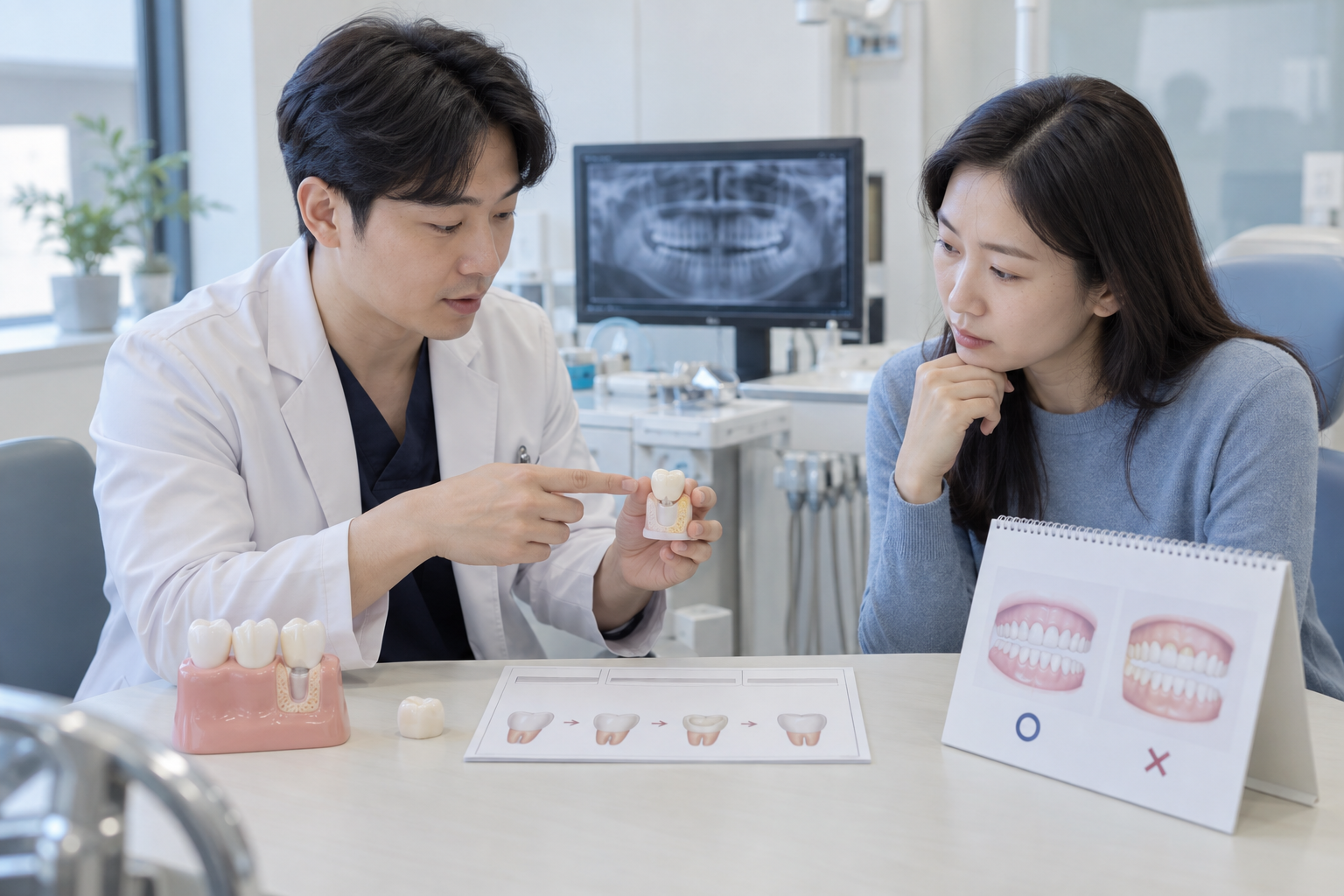
Compare diagnosis, tooth preparation, material rationale, temporary restoration, bite adjustment and return conditions.
A crown consultation is more than deciding to cap a tooth. It connects preservation, core or root-canal needs, material, bite and temporary care.
Compare clinics using the same records and scope, separating confirmed items from conditions that may change during treatment.
1. Rationale for a crown
Large restorations, cracks, fractures or weakened root-treated teeth create different rationales.
Record symptoms, examination, imaging evidence and alternatives. 'For longevity' alone does not establish current need.
- Record symptoms, examination, imaging evidence and alternatives.
- 'For longevity' alone does not establish current need.
Official sources for this sectionAmerican Dental Association MouthHealthy Crowns / American Dental Association Materials for Indirect Restorations / HIRA medical institution detail service
2. Preparation, core and root-canal scope
Remaining tooth and depth of decay or crack may lead to core or root-canal discussion.
Mark the trigger and decision point for each added procedure. A crown does not automatically require root-canal treatment.
- Mark the trigger and decision point for each added procedure.
- A crown does not automatically require root-canal treatment.
Official sources for this sectionAmerican Dental Association MouthHealthy Crowns / American Dental Association Materials for Indirect Restorations / HIRA medical institution detail service
3. Material rationale and alternatives
A material rationale should connect tooth position, remaining structure, load, opposing teeth and aesthetic demand.
Compare the proposal with at least one alternative by preparation, appearance, fracture, wear and cost. Frequent use of a material is not patient-specific justification.
- Compare the proposal with at least one alternative by preparation, appearance, fracture, wear and cost.
- Frequent use of a material is not patient-specific justification.
Official sources for this sectionAmerican Dental Association MouthHealthy Crowns / American Dental Association Materials for Indirect Restorations / HIRA medical institution detail service
4. Temporary crown and interim review
A temporary may help assess gum contour, contacts, speech, bite height and symptoms before the final crown.
Record wear period, food limits, contact if lost and items to revise before final fabrication. A temporary does not exactly predict final shape or feel.
- Record wear period, food limits, contact if lost and items to revise before final fabrication.
- A temporary does not exactly predict final shape or feel.
Official sources for this sectionAmerican Dental Association MouthHealthy Crowns / American Dental Association Materials for Indirect Restorations / HIRA medical institution detail service
5. Delivery-day bite and return criteria
At delivery, assess margins, floss contact, bite height, adjacent contacts and shade, documenting adjustments.
Obtain return rules for a high bite after numbness, pain, food trapping, loosening or fracture. Comfort on delivery day does not guarantee long-term fit or tooth health.
- Obtain return rules for a high bite after numbness, pain, food trapping, loosening or fracture.
- Comfort on delivery day does not guarantee long-term fit or tooth health.
Official sources for this sectionAmerican Dental Association MouthHealthy Crowns / American Dental Association Materials for Indirect Restorations / HIRA medical institution detail service
A same-condition consultation table
Record the evidence, effect on your plan and unresolved condition—not only yes or no.
| Criterion | Before the visit | At consultation | Interpretation limit |
|---|---|---|---|
| Rationale for a crown | Record symptoms, examination, imaging evidence and alternatives. | What finding supports a crown, and what more conservative option exists? | 'For longevity' alone does not establish current need. |
| Preparation, core and root-canal scope | Mark the trigger and decision point for each added procedure. | How much is preserved, and what triggers a core or root canal? | A crown does not automatically require root-canal treatment. |
| Material rationale and alternatives | Compare the proposal with at least one alternative by preparation, appearance, fracture, wear and cost. | Where do the proposed material and alternative differ for my tooth? | Frequent use of a material is not patient-specific justification. |
| Temporary crown and interim review | Record wear period, food limits, contact if lost and items to revise before final fabrication. | What will the temporary test, and how will feedback change the final crown? | A temporary does not exactly predict final shape or feel. |
| Delivery-day bite and return criteria | Obtain return rules for a high bite after numbness, pain, food trapping, loosening or fracture. | Which symptoms can be observed briefly, and which need prompt review? | Comfort on delivery day does not guarantee long-term fit or tooth health. |
| Quote scope | Separate diagnosis, temporary, lab, fit and adjustment | What triggers retreatment cost? | Material price alone is not the total |
| Records and follow-up | Record material, tooth and bite adjustment | What are the return criteria? | A warranty is a conditional policy, not an outcome guarantee |
What to verify
Ten questions to ask verbatim
- What finding supports a crown, and what more conservative option exists?
- How much is preserved, and what triggers a core or root canal?
- Where do the proposed material and alternative differ for my tooth?
- What will the temporary test, and how will feedback change the final crown?
- Which symptoms can be observed briefly, and which need prompt review?
- What alternatives preserve more tooth, and what are their limits?
- Why does the proposed material fit this site and bite?
- Does the quote include the temporary, lab work, cementation and bite adjustment?
- Who handles clinical and laboratory stages, and where are changes recorded?
- When and whom should I contact for pain, a high bite, loosening or fracture?
FAQ
FAQ
What matters most when checking rationale for a crown?
Large restorations, cracks, fractures or weakened root-treated teeth create different rationales. Record symptoms, examination, imaging evidence and alternatives. 'For longevity' alone does not establish current need. At consultation, ask “What finding supports a crown, and what more conservative option exists?” and record both the supporting finding and anything still unresolved.
What matters most when checking preparation, core and root-canal scope?
Remaining tooth and depth of decay or crack may lead to core or root-canal discussion. Mark the trigger and decision point for each added procedure. A crown does not automatically require root-canal treatment. At consultation, ask “How much is preserved, and what triggers a core or root canal?” and record both the supporting finding and anything still unresolved.
What matters most when checking material rationale and alternatives?
A material rationale should connect tooth position, remaining structure, load, opposing teeth and aesthetic demand. Compare the proposal with at least one alternative by preparation, appearance, fracture, wear and cost. Frequent use of a material is not patient-specific justification. At consultation, ask “Where do the proposed material and alternative differ for my tooth?” and record both the supporting finding and anything still unresolved.
What matters most when checking temporary crown and interim review?
A temporary may help assess gum contour, contacts, speech, bite height and symptoms before the final crown. Record wear period, food limits, contact if lost and items to revise before final fabrication. A temporary does not exactly predict final shape or feel. At consultation, ask “What will the temporary test, and how will feedback change the final crown?” and record both the supporting finding and anything still unresolved.
What matters most when checking delivery-day bite and return criteria?
At delivery, assess margins, floss contact, bite height, adjacent contacts and shade, documenting adjustments. Obtain return rules for a high bite after numbness, pain, food trapping, loosening or fracture. Comfort on delivery day does not guarantee long-term fit or tooth health. At consultation, ask “Which symptoms can be observed briefly, and which need prompt review?” and record both the supporting finding and anything still unresolved.
Can online information settle this decision?
A crown consultation is more than deciding to cap a tooth. It connects preservation, core or root-canal needs, material, bite and temporary care. Online information is a starting point for questions, not a substitute for examination and the treating clinician's explanation. Use these items as a checklist and mark missing information as unverified, not absent.
If two clinics disagree, what should I align first?
Compare clinics using the same records and scope, separating confirmed items from conditions that may change during treatment. First confirm that both clinics used the same records, goals and cost scope, then document why their answers differ and which further tests each needs. Align the actual clinician and follow-up scope as well as price and time.
When should I pause and seek more information?
Remaining tooth and depth of decay or crack may lead to core or root-canal discussion. Pause when the supporting findings, actual clinician, total scope or problem-response plan remains unclear. Ask for the missing record before committing; only an examining clinician can judge urgency. Record when the review will be completed and the next action so necessary care is not lost during the pause.